Aerial Yoga
Benefits of Aerial Yoga: Spine, Strength & Stress Relief
What aerial yoga actually does for your body and mind — spinal decompression, core strength, mobility, and nervous-system calm, explained class by class.
Aerial yoga gets attention for how it looks, but students keep coming back for how it feels. Suspending part of your body weight in a fabric hammock changes what your spine, joints, and nervous system are able to do in a single hour. Below is an honest look at the benefits of aerial yoga — what the hammock genuinely delivers, how quickly you notice it, and who tends to benefit most.
1. Spinal decompression and back relief
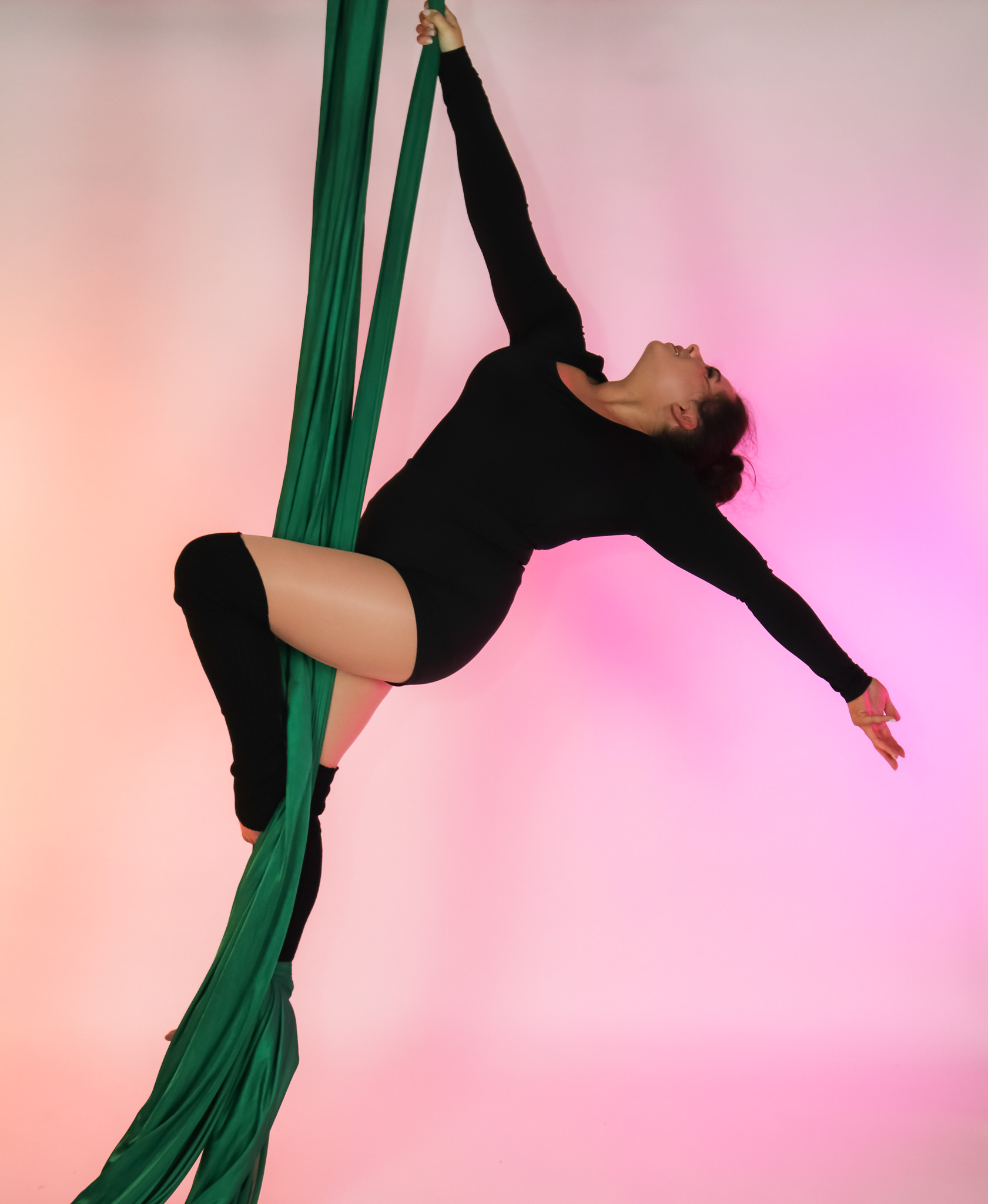
This is the benefit most students name first. Gravity compresses the spine all day: sitting, driving, lifting, scrolling. Hanging supported in the hammock reverses that load, creating gentle traction through the lumbar and thoracic spine. Instead of muscling your way into a stretch, you let the fabric hold you while the vertebrae get a little breathing room.
People with desk-job stiffness or chronic low-back tightness often report the clearest relief — a taller, looser feeling that lingers for a day or two after class. It is not a medical treatment, but as a consistent movement practice it takes real pressure off an overworked back.
2. Deeper, safer flexibility
Muscles only lengthen when they feel safe. When the hammock carries some of your weight, your hamstrings, hip flexors, and shoulders can relax into a stretch instead of bracing against gravity. That means better range of motion with less strain than the same pose on a mat.
- Supported forward folds without rounding or compressing the lower back
- Hip openers with the hammock taking the load off the standing leg
- Chest and shoulder opening that undoes hours of forward-hunched posture
- Assisted splits work with the fabric controlling how deep you go
3. Core strength without high impact
The hammock is never perfectly still. Every small sway asks your deep stabilizers — transverse abdominis, obliques, spinal erectors — to fire and correct. You build functional core strength through constant micro-adjustments rather than crunches, and your joints take almost none of the impact a floor workout would deliver.
4. Better balance, coordination, and body awareness
Moving while partially suspended scrambles your usual reference points, so your body has to rebuild them. That is proprioception training, and it transfers directly to everyday life: steadier footing, quicker recovery from a stumble, and more control in other sports. It is one reason aerial yoga is a strong complement to running, lifting, and dance.
5. Stress relief and nervous-system reset
Most classes end with a cocoon: fully wrapped in the fabric, weight completely supported, lights low. The combination of gentle compression, darkness, and slow breathing nudges you into a parasympathetic state — lower heart rate, slower breath, less mental noise. Students routinely describe walking out calmer than they have felt all week.
The hammock does something a mat can't: it lets you stop holding yourself up for a few minutes.
6. Posture correction that sticks
Decompression plus thoracic opening plus core engagement is exactly the combination that counteracts a forward-slumped posture. Over a few weeks of regular classes, the change shows up outside the studio — shoulders sitting further back, neck less jammed forward, standing feeling less effortful.
7. A low-barrier entry into aerial arts
Aerial yoga requires no pull-up strength and no prior yoga experience. The hammock is set to your height so your feet reach the floor whenever you want them to. For anyone curious about silks or lyra but unsure about the strength requirement, aerial yoga builds air confidence and grip familiarity first.
How soon do the benefits show up?
- After one class: spinal relief, looser hips and shoulders, noticeably calmer mood
- After 3–4 classes: less fear of inversions, easier hammock entries, better sleep on class nights
- After 6–8 weeks: visible posture change, stronger core endurance, measurable flexibility gains
Who should check with a doctor first
Inversions are not right for everyone. Tell your instructor before class — and check with your physician — if you have glaucoma or other eye pressure conditions, uncontrolled high blood pressure, recent surgery, a herniated disc, osteoporosis, vertigo, or if you are pregnant. Nearly every pose has a grounded variation, so most students can still take class safely with modifications.
Try aerial yoga in Chester, NY
Flexibility in Flight runs beginner-friendly aerial yoga at 16 Main Street in downtown historic Chester, NY, serving Goshen, Warwick, Middletown, Monroe, Sugar Loaf, and the wider Hudson Valley and Sussex County, NJ. New students can use the New Student Special — 5 classes for $76 within 90 days — to feel these benefits for themselves before committing to a package.